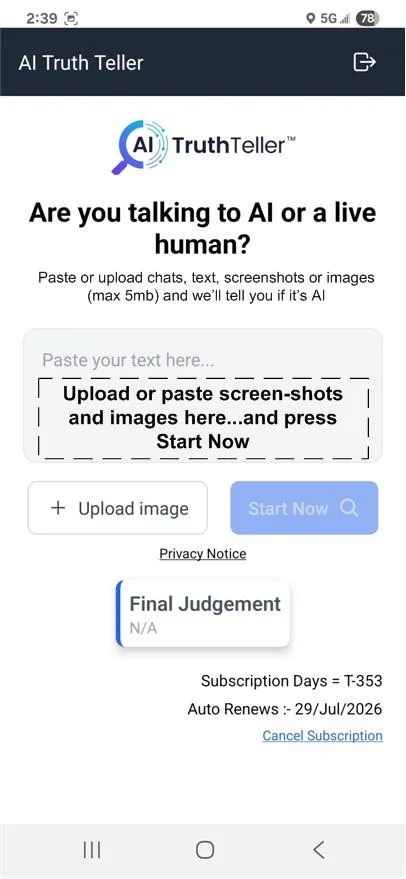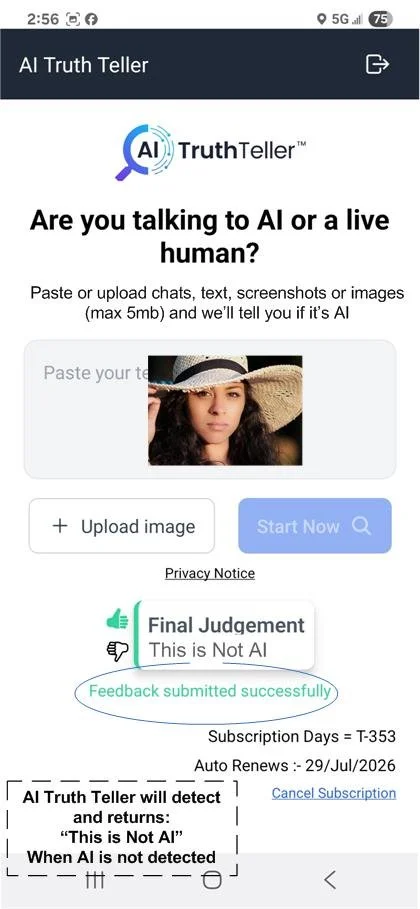


Are you texting and chatting with AI or a live Human?
Avoid deception and catfishing - before they hook you!
We detect fake photos, text and chatbots. You’re protected from scammers, liars and cheats who only want to play on your emotions and lead you down a primrose path. Using advanced AI we help you stop the deception with the first text or picture - and we give you tools to assess interactions beyond the first text, image and day one conversation.
We identify patterns of deception through long-tail analytics and detect human-like chatbots. Chatbots are becoming more sophisticated, sometimes using weeks or months to lull you into trust before they deceive and create havoc in your life.
Download now to get your free 60-day trial!
Click Here to download from the Google Play store. (scroll down to see app screenshots)
Click Here to download from the Apple App store. (scroll down to see app screenshots)
Click Here to download the Chrome Extension (scroll down to see WhatsApp screenshots)


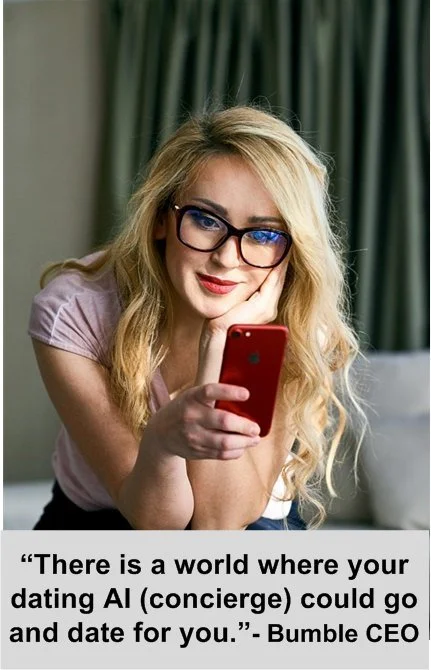

How to Prevent Deception in Online Romance and Dating





Fraudulent Trading Platforms - lookups
Commodity Futures Trading Commission Red List
SEC Unregistered Soliciting Entities Pause List
Legitimate brokerage platforms:
Fidelity
Charles Schwab
Vanguard
JP Morgan Chase
Etrade Morgan Stanley
Interactive Brokers
Robinhood
Merrill Edge
SoFi Invest
There are of course others but these are some of the largest and most easily recognized.
Online dating is difficult! There a many opinions on what it should look like, where you should play, how to protect yourself and a host of other options. You may not even think of it as dating if you’re simply involved in an online romance.
In the following paragraphs we explain how to use AI TruthTeller® so you can have more safety in online dating. We will show how to ferret out the liars, cheats and deceptions.
What follows is an article posted to a web site about dating, warning signs and how to stay safe as the backdrop. Follow along and see how we use AI TruthTeller to avoid deception and outsmart bad actors within each of the 11 Warnings. All of my comments are in italics:
For starters, we pasted the entire article (over 4,000 words) into AI TruthTeller and discovered - the dating advice presented in this article is AI generated. Funny isn’t it, taking dating advice from a computer… but before we digress let’s move on:
Online Dating Scams: 11 Warning Signs and How to Outsmart Them: Looking for Love Shouldn’t Mean Risking Your Identity or Your Savings
Online dating has changed the way people meet. {According to the research[1] 39% of couples met online as far back as 2017 and it’s much higher today. On a personal note, my wife and I met online. She swiped right and I responded.}
Millions of singles now use dating apps[2]{one in three U.S. adults} and websites every day to build friendships, find long-term relationships, or simply meet new people. Technology has made connecting easier than ever before, allowing conversations to begin across cities, countries, and even continents.
Unfortunately, the same technology that makes online dating convenient also makes it easier for scammers to deceive unsuspecting victims[3] , [4]{yep, 70,000 people lost $1.3 billion}.
Romance scams have become one of the fastest-growing forms of online fraud[5] / [6]{Certainly true in dollars reported as lost but it’s hard to say based on quantifiable research trends. In either case, the losses are real and the likelihood you will encounter an online scammer is over 50%. It may be that scammers are simply hunting bigger targets. As my daughter would say – they only go after people with stupid money. Not that the people are stupid, but they have so much money, they don’t take care of it anymore. They are careless with their money}.
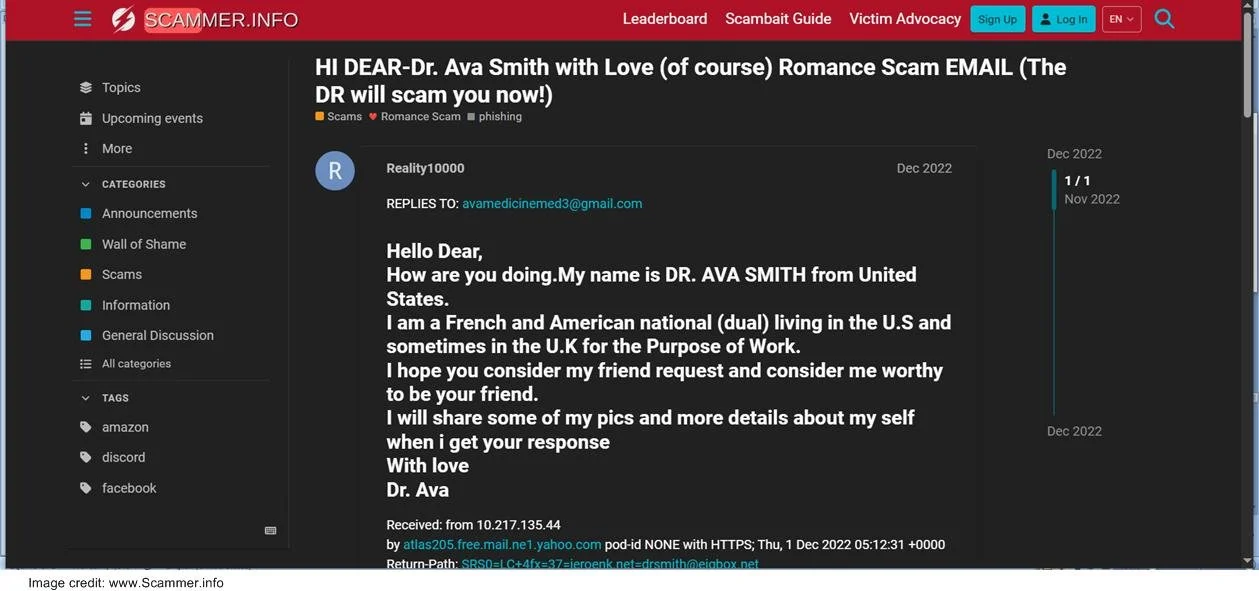
Criminals no longer rely on poorly written emails or obvious fake identities (e.g. Lord Sutan Abubakar de 1st , Lord Sumuel S. Numoma, Lord Nelson Rolihlahla Mandella). Here is one email example:
“Hello Dear,
How are you doing.My name is DR. AVA SMITH from United States. I am a French and American national (dual) living in the U.S and sometimes in the U.K for the Purpose of Work.
I hope you consider my friend request and consider me worth to be your friend. I will share some of my pics and more details about my self when I get your response.
With love
Dr. Ava
Original email from Dec 2022, with server details, can be found here at scammer.info”
AI TruthTeller easily identifies this email as written by AI, alerting you to a higher probability of deception.
Today’s scammers use convincing stories, stolen photographs[7], artificial intelligence, deepfake technology, professionally written messages, and even AI-generated voices to create relationships that appear completely genuine.
As mentioned in the ABC News Chicago story, doing a reverse image search on Google is great first step. Using AI TruthTeller to assess and detect deception is also a necessary step. Scammers are evolving their business into industrial operations with scale and the use of technology. Example, it’s not difficult to scrape images from the web. These can be used to build a database, track usage of the image and always present a “fresh” picture for the scam factory. Each one of these images could also be fed into an AI engine for alteration presenting a new and truly unique image. Reverse search will only go so far and will become increasingly ineffective as AI technology improves and scammers embrace AI and scale up shops that ramp up the scam process.
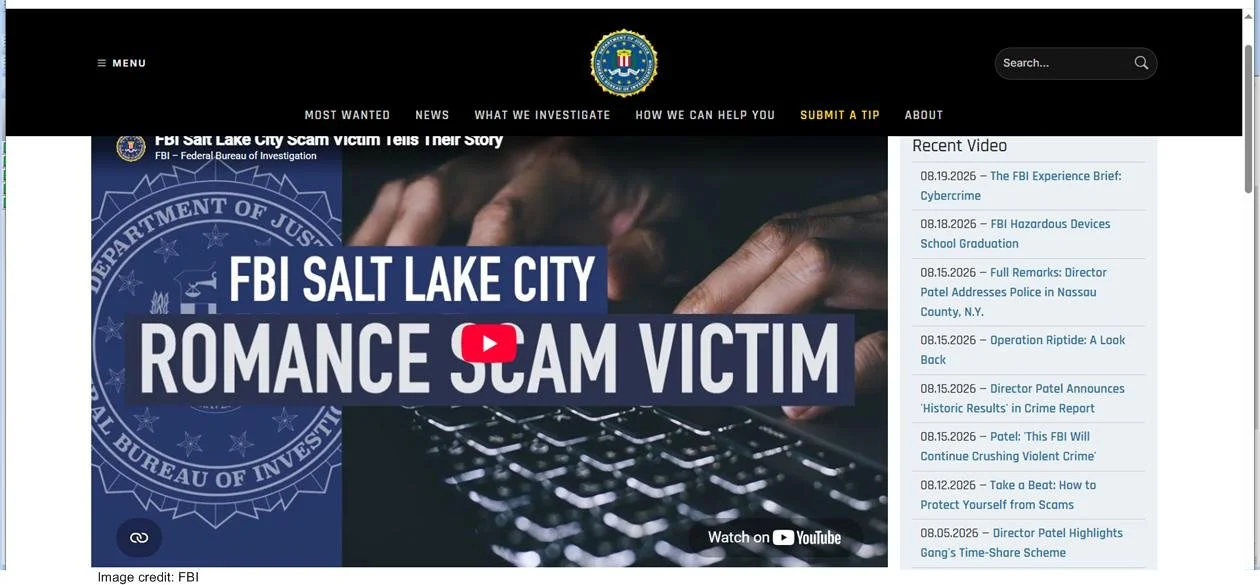
{Watch the video and notice the background shows lengthy text messages from the scammer to the victim. This is where you identify and trap the scam before they hook you, before you get emotionally attached. AI TruthTeller raises the red flag on deception, identifying AI early on so you can make a better decision and disengage.}
Many victims are intelligent, cautious people who never imagined they could become targets. Romance scammers succeed not because their victims are careless, but because they understand human psychology. They know how to build trust, create emotional attachment, manufacture urgency, and exploit loneliness before asking for money or personal information.
Click through on the human psychology link and see some of the research on how AI is more persuasive than humans. This is meaningful and should be noted by everyone involved in online dating. Romance scammers can use AI to persuade targets to believe the scam they are spinning and they can do it with minimal information. Just think what they can do with what’s posted in a Facebook profile.
The financial losses are staggering, but the emotional damage can be even greater. Victims often experience embarrassment, broken trust, anxiety, and emotional trauma long after the scam has ended. (I recently became aware of a woman who lost over $500,000 in a romance scam. In a separate instance a couple lost more than $75,000 in a fake FBI sting operation.)
Fortunately, there are warning signs that appear repeatedly across most dating scams. Learn to recognize these red flags dramatically reduce your chances of becoming a victim.
This guide explains eleven of the most common warning signs, why scammers use them, and practical steps you can take to protect yourself while still enjoying online dating.
Why Online Dating Scams Are Becoming More Sophisticated
Years ago, spotting a romance scam was often relatively easy. Messages were filled with grammatical errors, profile pictures looked suspicious, and requests for money came almost immediately. Today’s scams are different. Artificial intelligence has dramatically lowered the barrier for criminals. They can now:
· Create highly realistic profile photos.
· Write fluent, personalized conversations.
· Translate messages into nearly any language. « AI TruthTeller is multi-lingual
· Generate convincing life stories.
· Clone voices.
· Produce realistic video and audio.
· Operate dozens of fake identities simultaneously.
Some criminal organizations even manage romance scams as full-time businesses. Different individuals may handle profile creation, daily conversations, financial requests, and technical support. The person you’ve been speaking with for weeks may not even be the same individual who joins a video call.
This is a fact. One of the women I know of met with three different men, each one at a different time. It was a team effort online, over the phone, in person and in coaching her through the process to withdraw large sums of cash at her bank. Significant financial loss occurred.
The industrialization of online deception means users need to rely on instinct and objective verification.
Instinct is not enough. Objective verification is also part of the puzzle. Everyone needs technology tools today that enhance your human abilities, even while giving you final say on decisions. Avoiding deception is not a hands-off, leave it to technology kind of experience. Technology and people need to work together. This is what some people call the Centaur effect and is supported by recent resear
Warning Sign #1: Their Profile Seems Almost Too Perfect
One of the first clues often appears before the first conversation even begins. Scammers understand exactly what attracts attention. Their profile may feature:
· Exceptionally attractive photographs « validate these with AI TruthTeller
· Luxury travel destinations
· High-paying professions
· Interesting hobbies
· Perfect lighting « AI TruthTeller detects unnatural lighting in images
· Professional-quality portraits « validate these with AI TruthTeller
· Inspirational biographies « validate these with AI TruthTeller
· Seemingly flawless lifestyles « validate these with AI TruthTeller
While attractive people certainly exist, scammers intentionally create profiles designed to appeal to the widest possible audience.
Many now use AI-generated images that don’t belong to any real person. Others steal photographs from social media, modeling portfolios, military personnel, or business professionals.
The result is a profile that appears authentic but cannot be traced to an actual individual.
What You Should Do
Don’t automatically assume an attractive profile is fake. Instead:
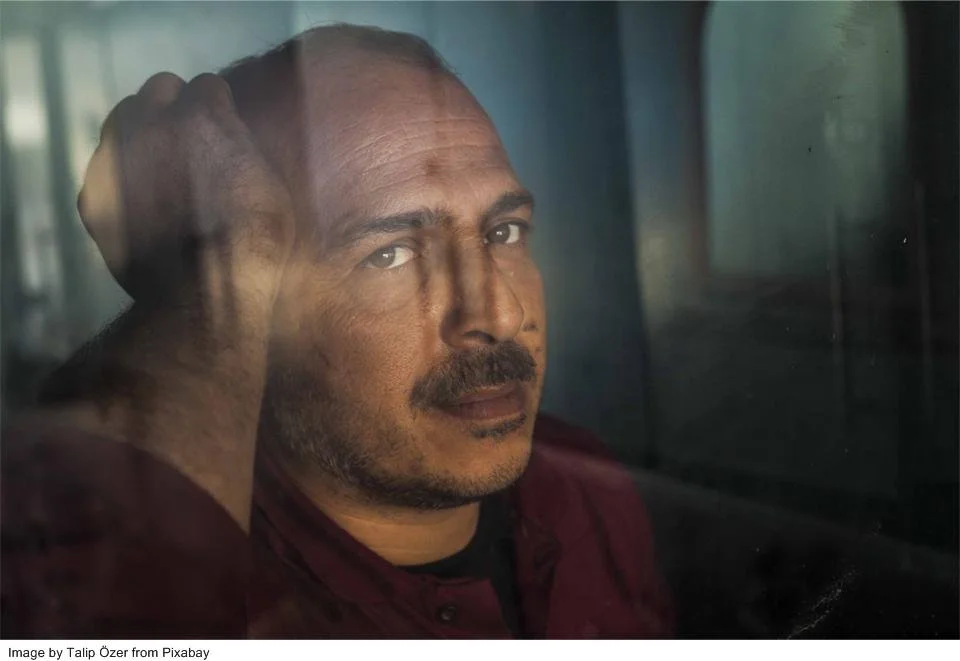
· Perform a reverse image search. « this story shows why a reverse search is useful. The man in the story has had his image used in multiple fake social media accounts. View and read it here:
· Examine whether every photo appears professionally staged.
· Look for inconsistencies in backgrounds, clothing, or locations.
· Ask questions about places shown in the photographs.
· Be cautious if every image appears unusually polished.
Modern AI images have become extremely convincing, so image verification should be one step—not your only step—in evaluating authenticity.
AI TruthTeller® includes multiple tools to avoid deception on the “too perfect profile”: AI image detection, photographic forensic data, AI text detection and the Facebook Scam Scan. We assess perfect lighting, exceptional photographs, professional portraits, inspirational writing in biographies and mismatches in geography and many more. If you can get an original photograph, instead of one take from a social media platform, the forensic data should be intact and will be extremely useful in knowing whether the image of the person is AI generated, enhanced, manipulated or is a real photograph.
Warning Sign #2: They Develop Strong Feelings Extremely Quickly
Healthy relationships take time. Scammers know they don’t have that luxury. Instead, they accelerate emotional intimacy. Within days—or sometimes hours—you may hear statements like:
· “I’ve never met anyone like you.” « validate the conversation with AI TruthTeller
· “I think we’re soulmates.” « validate the conversation with AI TruthTeller
· “I already feel like I know you.” « validate the conversation with AI TruthTeller
· “You’re exactly what I’ve been searching for.” « validate the conversation with AI TruthTeller
· “I think I’m falling in love.” « validate the conversation with AI TruthTeller
At first, these messages can feel flattering. Psychologically, rapid affection creates emotional momentum. Once someone begins imagining a future together, they become less likely to question inconsistencies. This technique is commonly known as love bombing. Love bombing overwhelms victims with:
· Constant compliments « validate the conversation with AI TruthTeller
· Continuous messaging « validate the conversation with AI TruthTeller
· Emotional vulnerability
· Future planning
· Daily check-ins
· Romantic promises « validate the conversation with AI TruthTeller
The goal isn’t romance, it’s dependency. Once emotional investment forms, logical skepticism often declines.
What You Should Do
Healthy relationships develop through shared experiences over time. Be cautious when someone:
· Declares love unusually early.
· Talks about marriage before meeting.
· Refers to you as a soulmate almost immediately.
· Pushes for exclusivity within days.
· Discourages you from talking with other people.
Real intimacy grows naturally. Artificial intimacy is often engineered.
Four days and you’re hooked! This is a factory worker, acting as a so called butcher, handling up to 100 different prospects/victims in a single work shift. https://www.rd.com/article/ai-romance-scam-four-days/
How does AI TruthTeller help? Words matter and AI generated text can be detected. The longer the conversation, the better. The Chrome Extension of AI TruthTeller has the unique ability to assess text over multiple chat sessions. Turn on the “Observe” mode for easy detection of continuous conversational sessions; use the copy and paste function to assess conversations transpiring over over multiple sessions, hours, days, weeks or months. Patterns emerge and detection happens!
Warning Sign #3: They Always Have a Reason They Can’t Meet
Perhaps the biggest red flag in online dating is an endless series of excuses for avoiding an in-person meeting—or even a live video conversation. Scammers commonly claim they are:
· Working overseas
· On an oil rig
· Traveling internationally
· Doctors on humanitarian missions
· Engineers on temporary assignment
· Contractors in remote locations
· Diplomats
· International business executives
These stories accomplish two things. First, they explain why meeting isn’t currently possible.
Second, they create an aura of credibility and importance. When meeting eventually becomes possible, another emergency suddenly appears. Common excuses include:
· Flight cancellations (ask for the airline and flight number. You can help find an alternate carrier. If their not interested, this is a clue, their intentions are not good)
· Lost passports
· Family emergencies
· Customs delays
· Military deployment
· Business obligations
· Internet problems
Weeks become months. Months become years.
AI TruthTeller can help when conversations extend over weeks and months. IF you are using a consistent platform for communication, you can copy and paste extensive conversations. These long form conversations are way different than a few brief text messages or chat sessions. They include everything you’ve talked about shared. This level of detail helps protect you and gives AI TruthTeller lot of text to assess, analyze and detect artificial intelligence. Today’s scammers are scaling up. It is become big business and industrialized. They are using AI to scam dozens and hundreds of people at the same time. AI TruthTeller can help you detect this type of scam operation.
Yet the relationship somehow never progresses beyond messaging.
The Video Call Trap
Some scammers now agree to video calls. However, these calls may be:
· Extremely brief
· Poor quality
· Pre-recorded clips
· AI-generated Deepfakes
· Carefully staged conversations
· Limited by convenient “technical issues”
A single video call should not automatically convince someone that the individual is genuine. Consistency matters far more than one carefully controlled interaction.
What You Should Do
If someone continually postpones meeting despite expressing serious romantic interest, ask yourself a simple question:
If they genuinely wanted a relationship, what would realistically prevent them from making concrete plans after several months?
Legitimate obstacles can occur. Endless obstacles usually indicate something else.
Why Verification Matters More Than Ever
One of the biggest challenges today is that appearances alone are no longer reliable indicators of authenticity. Photographs can be generated. Voices can be cloned. Videos can be manipulated. Messages can be written by AI.
That doesn’t mean every online interaction is fraudulent. It simply means users should place greater emphasis on verifying identity through multiple independent signals rather than relying solely on emotion or first impressions.
The safest approach combines healthy skepticism with practical verification. Ask questions that require personal knowledge, look for consistency over time, verify details through independent sources when appropriate, and avoid making important decisions based only on digital interactions.
Be careful with in–person meetings. In this story reported by Reuters, an elderly man was enticed to meet someone to travel to New York City. He never came home alive.
https://www.reuters.com/investigates/special-report/meta-ai-chatbot-death/
In contrast, I know a man who met a woman online, who was in a far off city. She was a complete and total stranger to him. He arranged to meet her for dinner in her home town. Before flying off to the distant city, he made phone calls to people in the area including family members; he checked public records and did searches on social media sites. He looked for connections based on the Six Degrees of Separation theory (any two people on earth are connected by no more than five people in-between). He discovered his sister was close friends with one of her (the date) close friends. His niece, also in the area, had been to large group camping events with her. Lastly, when they first met, it was in a popular and very public restaurant and his sister went with him. Too much caution? Or just the right amount? You can decide, but for the Chef in the Reuters story it would have been wise to have another person with him.
[1] Meeting online is now the most popular way that couples meet. Stanford University, Humanities and Social Sciences; published in Proceedings of the National Academy of Sciences; 20 August 2019. Disintermediating your friends: How online dating in the United States displaces other ways of meeting | PNAS
[2] One in three U.S. adults admit to having used online dating apps, and that’s across all adults. For those under 30, in the 18-29 years range, it is 53%. Source: Pew Research Center, 2 February 2023 https://www.pewresearch.org/internet/2023/02/02/from-looking-for-love-to-swiping-the-field-online-dating-in-the-u-s/
[3] Over 50% of users of online dating apps say they have come across scammers of one kind or another. Source Pew Research Center, 2 February 2023. Equally as disturbing, from the same survey, 72% of men who recently used dating apps report encountering scammers.
[4] Fortunately not everyone gets duped, even when they meet a scammer. However, 70,000 people is a big number and $1.3 billion in losses is a lot. No doubt this number is smaller than actual losses. I mean, who wants to talk about how they were duped by a scammer. Source: https://www.ftc.gov/news-events/news/press-releases/2023/02/new-ftc-data-reveals-top-lies-told-romance-scammers
[5] And the winners are – a) Help! I’m in jail! B) Let me show you how to invest c) I’m in the military far, far away and need help d) Dude! Help me make this critical delivery, etc, etc. Source: https://www.ftc.gov/news-events/news/press-releases/2023/02/new-ftc-data-reveals-top-lies-told-romance-scammers
[6] Bigger losses from fewer reported scams. Source: The Trajectory of Romance Scams in the U.S. https://arxiv.org/abs/2405.03828
[7] This is all too common! Here is one such instance, thoroughly covered by ABC News, Chicago https://abc7chicago.com/post/man-says-romance-scammers-have-been-using-picture-attract-women-15-years/18148265/
Warning Sign #4: They Want to Leave the Dating Platform Almost Immediately
Most dating platforms invest heavily in protecting their users. They employ automated fraud detection, monitor suspicious behavior, and provide convenient tools for reporting fake accounts. While no platform catches every scammer, these safeguards make it more difficult for criminals to operate undetected.
Scammers know this.
That’s why one of their earliest objectives is often to move the conversation somewhere else.
Within a few messages, they may suggest continuing the conversation through:
· WhatsApp « the Windows Extension of AI TruthTeller® is integrated with WhatsApp, giving you an Observe mode and one-click assessment of the conversations. Use it to detect AI generated text and stay safe. WhatsApp privacy is great when chatting with people you know and trust, but it is a protected greenhouse for scammers that want to harvest and steal your lifetime savings.
· Telegram
· Signal
· Google Chat
· Text messaging
All of the messaging apps listed here are ideal environments for AI TruthTeller to increase your online safety. Simply copy and paste, text and images into the drop down window of the app. Better AI awareness. Better decisions. Better safety.
The request may seem harmless.
“We never check this app.”
“My notifications don’t work here.”
“I don’t like using dating apps.”
“Let’s text instead.”
There are certainly legitimate reasons why someone may prefer another messaging platform. The problem isn’t the request itself—it’s the timing.
Moving the conversation away from the dating site removes many of the protections designed to detect suspicious behavior. It also makes it easier for scammers to delete their dating profile without losing contact with potential victims.
Why This Matters
Dating platforms often analyze patterns such as:
· Repeated copy-and-paste introductions
· Accounts contacting unusually high numbers of users
· Multiple reports from other members
· Suspicious login locations
· Fake profile indicators
Once communication shifts elsewhere, those protections largely disappear.
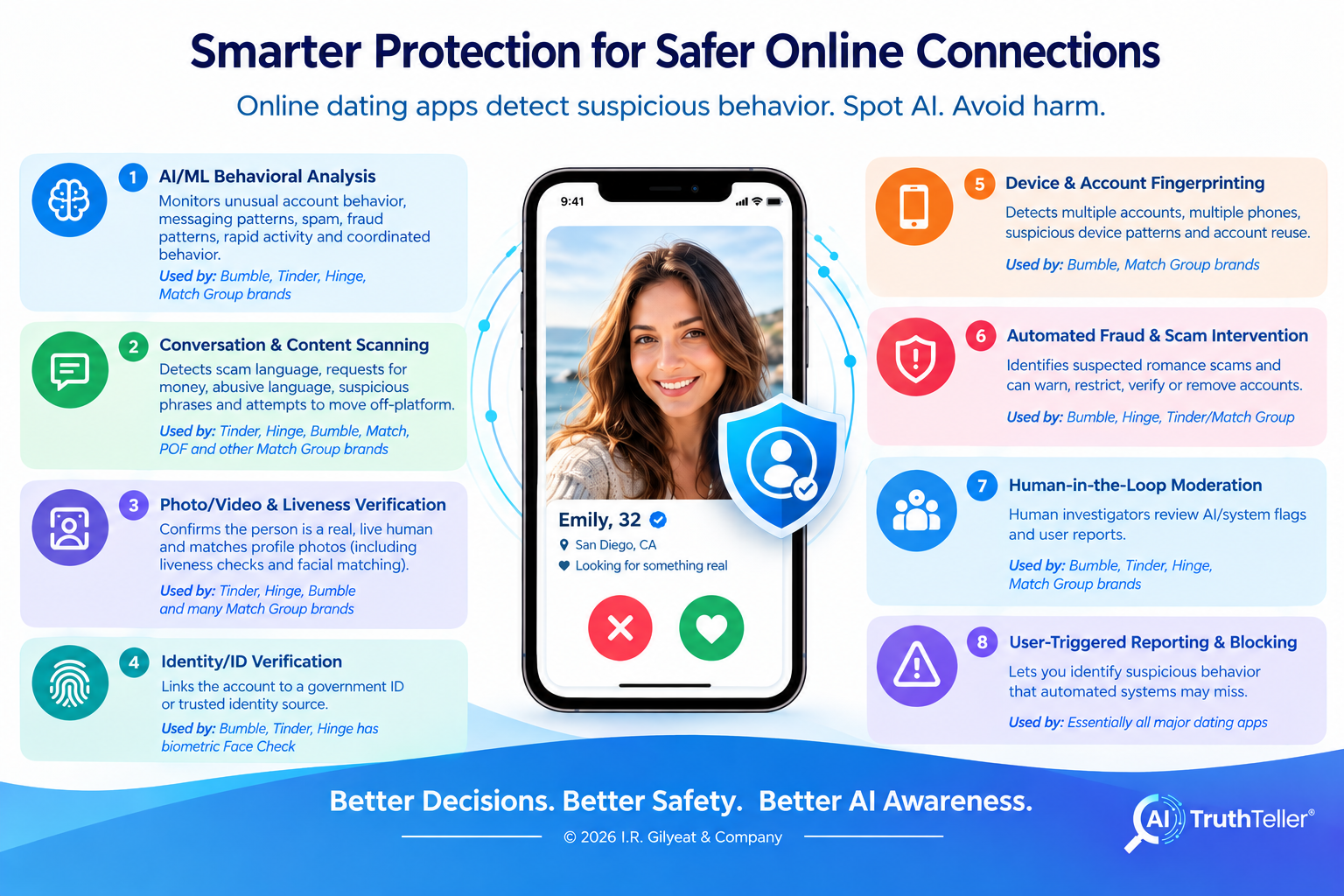
It’s clear from the chart to the left, dating platforms have invested significantly into technology that helps their users feel more safe. Each of major apps are making major strides. This is good as long as you stay on their platform. AI TruthTeller adds another layer of safety across all of these platforms, including text messaging, email and each of the messaging apps listed earlier. It also closes gaps. Consider a scammer who:
passes facial verification,
uses his own photograph,
has a legitimate phone,
has no previous reports,
behaves normally for several weeks,
and then uses AI-generated text to conduct a romance scam.
Remember the Phone Farm image. Romance scams can spin up hundreds of phones and conduct hundreds of one-to-one deceptions at scale. Online scams are big business with every consumer a potential target. AI TruthTeller closes gaps like the scammer example just shared.
What You Should Do
There’s no need to refuse every request to move the conversation, but don’t feel pressured to do so immediately. « AI TruthTeller is technology that travels with you on and off the various platforms.
Consider staying on the dating platform until you’ve had enough conversations to feel comfortable that the individual is genuine. A legitimate person will typically respect your desire to communicate where you feel safest.
If someone becomes impatient or argumentative because you prefer to remain on the dating platform a little longer, consider that a warning sign rather than an inconvenience.
Warning Sign #5: Their Story Doesn’t Quite Add Up
Most successful scammers prepare convincing biographies.
Unfortunately for them, maintaining a fictional life over weeks or months is surprisingly difficult.
Small inconsistencies eventually emerge.
Perhaps they say they grew up in one country but later reference attending high school somewhere else.
Maybe they describe working night shifts but consistently message during hours that don’t align with their stated time zone.
They might claim to be an experienced physician yet misunderstand basic aspects of medical practice.
These inconsistencies often appear insignificant individually.
Taken together, they reveal a larger pattern.
Common Inconsistencies Include:
· Changing ages or birthdays
· Different employment histories
· Conflicting family details
· Inconsistent travel stories
· Time zone discrepancies
· Contradictory educational backgrounds
· Varying relationship histories
· Mismatched photographs and locations
Professional scammers sometimes juggle conversations with dozens of people simultaneously. Keeping every fabricated detail consistent becomes increasingly difficult over time.
» AI TruthTeller can be helpful in identifying inconsistencies. Our Facebook Scam Scan looks for inconsistencies within profile data. We look at their stated age, location data, check-ins and biographical signals such as employment, education and relationship status. Your human judgement is required but when you see a “high risk” assessment from the Facebook Scan Scam and combine that with your feelings of unease and personal observations, you can be more confident someone is trying to scam you. Shut it down and walk away.
How to Recognize the Pattern
Instead of looking for one dramatic lie, pay attention to repeated contradictions. Ask yourself:
· Do important details change over time?
· Are explanations vague when questioned?
· Do answers become defensive rather than informative?
· Are stories becoming increasingly complicated?
People naturally forget minor details from time to time. Consistent contradictions involving major life events deserve closer scrutiny. « AI TruthTeller with the Facebook Scam Scan looks back in time, revealing a more complete assessment of the person.
Warning Sign #6: They Begin Asking Personal Questions Surprisingly Early
Healthy relationships involve learning about one another.
Scammers understand this and often disguise information gathering as ordinary conversation.
Initially, their questions may seem perfectly reasonable.
Where do you live? « increases risk; be vague (e.g. on the west coast)
Do you own your home? < increases risk; do not answer
What do you do for work?
Do you live alone? « high risk, do not answer. Nobody online needs to know this.
Have you been married?
How many children do you have? « increases risk; save the details for later.
What bank do you use? « high risk, do not answer. Nobody online needs to know this.
When do you usually travel? « increases risk; be vague (e.g. I travel whenever I want to)
Which social media platforms do you use?
Over time, these questions may become increasingly specific.
Individually, each answer appears harmless.
Collectively, however, they help criminals build a detailed profile that can be exploited in several ways.
Why Criminals Collect Personal Information
Personal details may be used to:
· Build trust by referencing previous conversations.
· Guess passwords or security questions.
· Target financial scams more effectively.
· Commit identity theft.
· Impersonate you online.
· Tailor future fraud attempts.
· Research your family members.
· Determine your financial situation.
Modern scammers frequently combine information gathered from dating conversations with publicly available social media profiles, online records, and data breaches.
The more information they possess, the more convincing future scams become.
Protecting Yourself
Ask yourself whether the information you’re sharing is appropriate for someone you’ve never met.
There’s a significant difference between discussing favorite hobbies and revealing financial details, your daily routine, or sensitive personal information.
A trustworthy relationship develops gradually. You don’t need to disclose everything simply because someone asks.
Warning Sign #7: They Create One Emergency After Another
Once trust has been established, many romance scams enter a predictable phase.
A crisis suddenly appears.
It rarely begins with a large request.
Instead, scammers often start small.
Perhaps they missed a flight.
Their wallet was stolen.
Their child needs medication.
Their laptop broke.
Their phone was damaged.
Their bank account is temporarily frozen.
Customs officials won’t release an important package.
An unexpected medical expense has arisen.
The emergency sounds believable.
The amount requested may even seem modest.
The goal isn’t merely obtaining money.
It’s measuring your willingness to help.
The Foot-in-the-Door Technique
Behavioral psychologists have long observed that people who agree to a small request are often more likely to agree to larger ones later.
Scammers exploit this principle.
A request for $100 today may become $500 next month and several thousand dollars after that.
Each payment reinforces the illusion that the relationship is real and that the previous investment should not be wasted.
Victims often continue sending money because they believe the next payment will finally resolve the crisis.
Unfortunately, there is almost always another emergency waiting.
Emotional Manipulation
Notice how these requests are typically framed.
“I hate asking.”
“I’ll pay you back next week.”
“You’re the only person I can trust.”
“I’ve never asked anyone for help before.”
“I don’t know what else to do.”
The objective is to make saying “no” feel emotionally difficult.
The request becomes less about money and more about proving your commitment to the relationship.
What You Should Do
As a general rule, avoid sending money to someone you’ve never met in person, regardless of how compelling the story sounds.
» This is not a general rule. This is a hard no! If you’re in dating circles or developing a romantic relationship with someone online, and they ask you for money this is a flaming red warning! End the relationship.
This includes:
· Wire transfers
· Cryptocurrency
· Gift cards
· Cash transfer services
· Bank transfers
· Digital payment apps
Legitimate relationships are built on trust—not financial rescue missions.
If someone you’ve never met asks for money, treat it as a major warning sign.
————————————————
How Scammers Build Emotional Dependency
Many people assume romance scams are primarily financial crimes.
In reality, they are often emotional confidence schemes. « Emotional confidence is not a crime. It may violate trust with a spouse and create chaos or dependency in your life, but the crime happens when they steal from you. Scammers use emotional confidence as a tool to pry your hard earned money out of your hands and into their bank accounts.
Money usually comes later.
The first objective is earning trust.
Professional scammers invest considerable time learning what matters to you.
They ask about your dreams, fears, career, family, past relationships, and future goals. They remember birthdays, congratulate accomplishments, offer encouragement during difficult times, and become a consistent presence in your daily routine.
Over weeks or months, they may become one of the first people you message each morning and the last person you speak with before bed.
This routine creates emotional familiarity.
» If you find yourself involved in a relationship like this, AI TruthTeller can help. Scammers are scaling their operations through the use of AI. This is an industrial butchering operation and they are grooming victims by the dozens. AI is learning from dozens, hundred and thousands of people simultaneously. It is personalizing at scale, and priming the relationships for a fat payday.
Psychologists sometimes refer to this as the “mere exposure effect”—the tendency for repeated interaction to increase feelings of comfort and trust. Scammers take advantage of this natural human response by maintaining frequent, positive communication.
The stronger the emotional connection becomes, the more difficult it can be to objectively evaluate warning signs. Victims often find themselves explaining away inconsistencies because they want the relationship to be genuine.
That is why periodic reality checks are so important. Consider discussing your online relationship with a trusted friend or family member. Someone outside the relationship may notice patterns that are difficult to see when emotions are involved
In the sections to follow we’ll examine the final four warning signs, including investment scams disguised as romance, AI-generated identities, Deepfake technology, and practical methods for verifying whether the person you’re communicating with is who they claim to be.
Warning Sign #8: They Introduce an Investment or Financial Opportunity
By this stage, the relationship may feel genuine.
You’ve been talking for weeks or even months. Conversations have become routine. You’ve shared personal stories, discussed future plans, and perhaps exchanged countless photographs and voice messages.
» If you’ve been talking for weeks and months, use the AI TruthTeller Chrome Extension to analyze the entire conversation. We know it will handle at least 8,500 words and more.
Then the conversation takes an unexpected turn.
Rather than asking for money directly, your online companion mentions a “great opportunity.”
They may casually mention:
· Cryptocurrency investing
· Foreign exchange (Forex) trading
· Gold or precious metals
· Real estate investments
· Exclusive investment platforms
· Online trading apps
· High-yield savings programs
· Business partnerships
At first, they’re not asking you to invest.
Instead, they tell you how much money they’ve made.
They send screenshots of impressive returns.
They explain how financially secure they have become.
Eventually, they offer to help you achieve the same success.
This variation of romance fraud—sometimes called “pig butchering”—combines emotional manipulation with investment fraud. Victims are encouraged to deposit increasing amounts of money into fraudulent trading platforms that appear legitimate but are entirely controlled by criminals.
Initially, victims may even be allowed to withdraw small profits. This builds confidence and encourages larger investments. Once substantial sums have been transferred, withdrawals suddenly become impossible due to fabricated taxes, verification fees, or technical issues.
Why This Strategy Works
People naturally trust recommendations from someone they believe cares about them.
By introducing investments only after trust has been established, scammers lower the victim’s skepticism.
The investment becomes another expression of the relationship.
“If I can help improve your financial future, why wouldn’t I?”
Protect Yourself
Treat any unsolicited investment recommendation from someone you’ve met online as a significant warning sign.
A genuine romantic relationship should never depend on financial opportunities, trading platforms, or promises of exceptional returns.
If someone insists that acting quickly is essential, that urgency is often designed to prevent careful research.
Warning Sign #9: They Avoid Independent Verification
Trustworthy people generally understand that online dating requires caution.
If you ask them to verify their identity, they may not love the request, but most recognize why it’s reasonable.
Scammers, on the other hand, often resist any form of independent verification.
They may object to:
· Live video conversations.
· Multiple video calls at different times.
· Taking a current selfie with a specific gesture or object.
· Meeting in person.
· Sharing verifiable professional information.
· Connecting through established social networks.
· Answering questions that confirm details they’ve previously shared
Instead, they’ll often respond with excuses.
“My camera is broken.”
“My employer prohibits video calls.”
“I value my privacy.”
“My internet isn’t good enough.”
“I don’t like social media.”
Occasionally, one excuse is legitimate.
A constant pattern of avoiding verification is not.
Verification Should Never Feel Offensive
Healthy online relationships are built on mutual trust.
Verification isn’t about accusing someone of dishonesty.
It’s about ensuring that both people are who they claim to be.
If someone reacts with anger simply because you ask for reasonable confirmation of identity, consider whether that response itself reveals more than the verification would have.
» Human-in-the-Loop is a practice we firmly believe in for AI TruthTeller. It has high value in avoiding deception and romance scams. You are the human in the loop. Your family and friends are as well. Ask them to join a video call and when you meet in person for the first time or two. Listen to them and use good judgement.
Warning Sign #10: Their Digital Presence Doesn’t Match Their Story
Most people leave digital footprints.
They appear in professional profiles, community organizations, sports clubs, alumni associations, local news stories, business websites, or years of social media activity.
Scammers often have remarkably thin digital histories.
» This is so true. Have you seen any social media PR professionals that have zero footprint? No press releases with their name, phone number and email. No stories in the trade rags highlighting their expertise. No interviews. Nothing. Red flasgs all of them. AI TruthTeller helps you see through the smoke and mirror of AI fabricated stories posted on social media and the looped back as source references to show their own expertise.
Perhaps their social media account was created only a few months ago.
» Or it references a legitimate company as proof of bonafides, but the company was registered just a few days or weeks ago.
Maybe every photograph was uploaded on the same day.
» Or every photo of the executive team of their company is AI generated
Perhaps there are very few comments from friends.
Or every interaction appears strangely generic.
While privacy-conscious individuals certainly exist, the complete absence of a believable digital history deserves closer examination.
Signs of an Artificial Digital Presence
Look for patterns such as:
· Recently created accounts.
· Very few tagged photographs.
· Minimal interaction from friends.
· Little evidence of long-term relationships.
· Identical photos across multiple names.
· Followers that appear fake or inactive.
· Posts clustered within short time periods.
· Generic comments that lack personal connection.
Remember, scammers know people perform basic searches.
Some now build fake social media profiles months or even years before using them.
That is why consistency across multiple independent sources is more valuable than any single profile.
Warning Sign #11: Something Feels Wrong—Even If You Can’t Explain Why
Human intuition isn’t magic.
It’s often your brain recognizing patterns before you consciously identify them.
Perhaps conversations seem oddly repetitive.
Responses sometimes ignore your questions.
Important details keep changing.
Stories become increasingly dramatic.
Everything feels just slightly…off.
People frequently dismiss these feelings because they don’t want to appear suspicious or cynical.
Scammers rely on that hesitation.
If your instincts repeatedly tell you something isn’t right, don’t ignore them.
Instead, slow the relationship down.
Ask more questions.
Verify more information.
Seek an outside opinion.
Trust should increase with evidence—not simply with time.
How to detect chatbots and deception in long conversations?
Copy and paste the full text history into AI TruthTeller® Windows Extension. We can assess and detect AI across multiple days, weeks and months.
AI TruthTeller® as a Windows Extension in WhatsApp provides an advantage: Observe mode. Start the observe mode and Extract the WhatsApp conversation for Final Judgement. A one-click process makes it easy to extract and render a Final Judgment. No copy and paste required. This is where long-term analysis happens. Analyze text across multiple days, weeks and months when chatting with a “person”. Today’s humanlike chatbots are sophisticated and you may not feel uncomfortable, like you’re being duped, until weeks or months into a conversation.

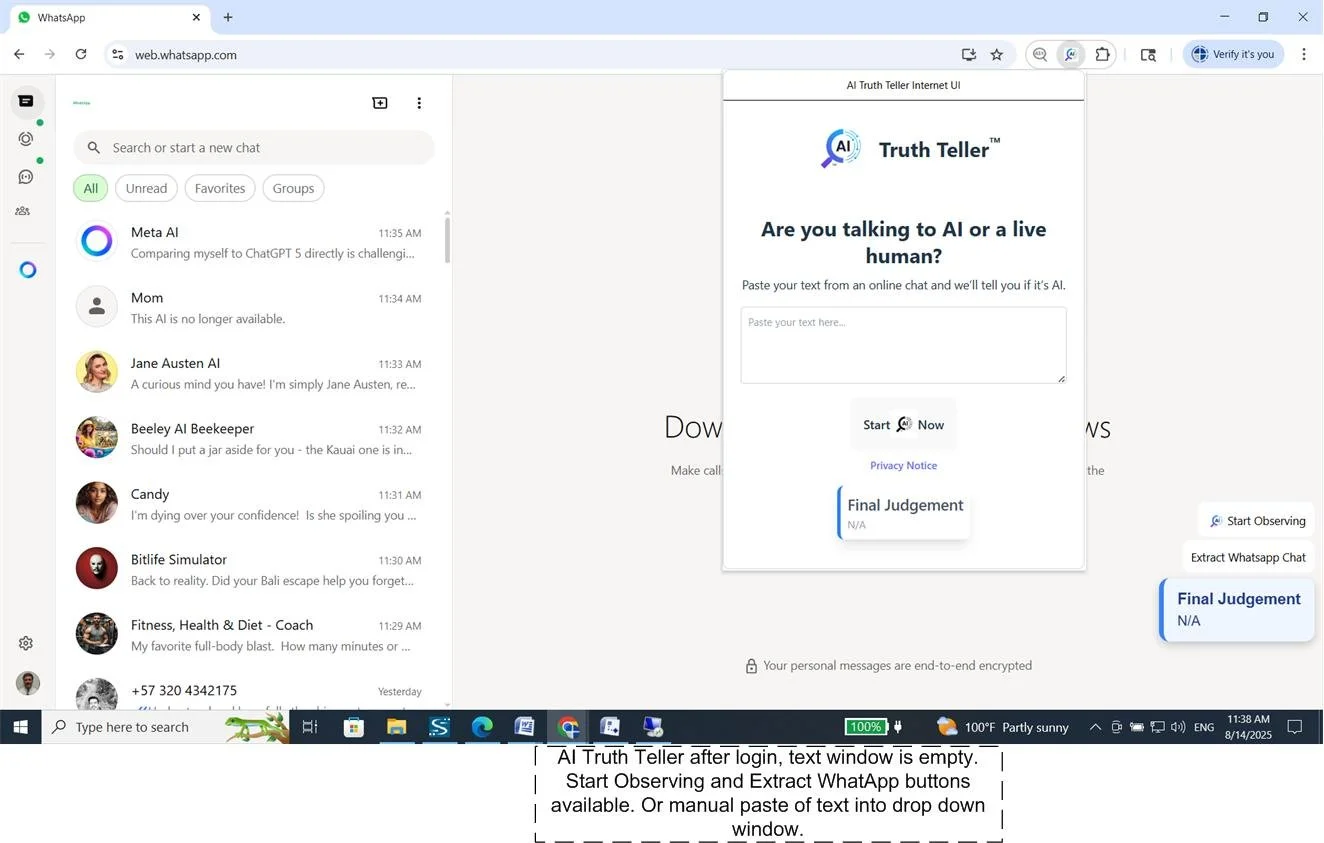


How to use AI TruthTeller® - in a few simple screenshots